



Blog
Villa Weddings in Spain
There is a particular kind of couple who, after months of looking at venues, arrives at a quiet realisation: they do not want a venue at all. They want a place that becomes theirs for a few days. No other party arriving the same afternoon, no service entrance shared with strangers, no clock running because the next booking is at eight. They want a house with grounds, a gate that closes behind them, and the freedom to decide what happens within it. That is the instinct behind a villa wedding in Spain, and it is the request we hear most often from couples who already know exactly the standard they expect.
A villa is not a banquet hall dressed up for the occasion. It is a private estate — a finca inland, a sea-facing property on the coast, a restored manor with its own gardens — handed over to you and your guests for the duration. The distinction matters more than it first appears, because it changes almost everything about how the day, and the days around it, can be designed.
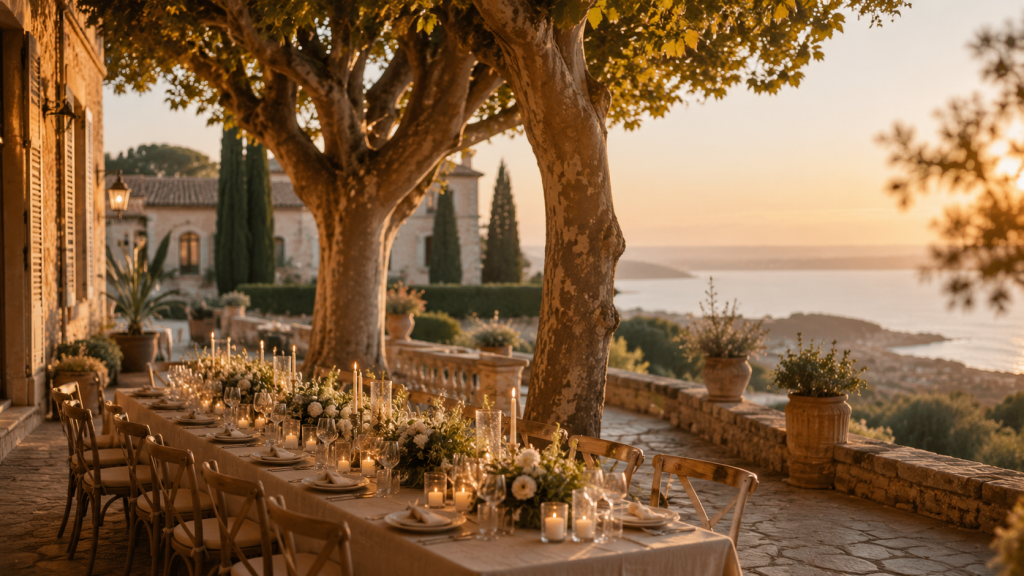
Wedding villa in Spain with a candlelit terrace dinner overlooking the sea
Why a villa wedding in Spain changes the whole celebration
The commercial venue, however beautiful, is built around throughput. It exists to host many weddings, which means standardised timings, prescribed flows, and a list of approved suppliers whose presence has more to do with the venue’s economics than with your taste. A villa inverts that logic entirely. Because the property is genuinely private for the period of your booking, the celebration is shaped around you rather than around the building’s schedule.
Privacy is the first and most obvious consequence, and for many of the couples we work with it is the decisive one. A wedding at a private villa is not visible to the public, not interrupted by another event, and not subject to the compromises that come with sharing a space. For a couple who values discretion — whether for reasons of profile, or simply because they consider their wedding a private matter — that seclusion is not a luxury detail. It is the entire point.
The second consequence is time. A villa is rarely a single afternoon. It is a Friday arrival, a long welcome dinner under the trees, the ceremony on Saturday, and a Sunday that drifts into what the Spanish call the sobremesa — the unhurried hours that follow a meal, when no one rises from the table because the conversation is better than anywhere else they could be. A villa gives you room for that rhythm. The wedding stops being an event and becomes a gathering, which is a different and, to the right couple, far more valuable thing.
What a villa wedding in Spain actually offers
When couples search for a wedding villa in Spain, they are usually picturing more than a pretty backdrop. The format carries practical advantages that a conventional venue cannot match.
A villa is, in the best sense, a blank canvas. The grounds are not pre-set with a fixed ceremony spot and a fixed dinner terrace; the layout is decided according to your guest count, the light at your chosen hour, and the experience you want to create. Dinner can move from a courtyard to a lawn to a terrace across the evening. The ceremony can face the sea or sit beneath old plane trees. Nothing is locked because nothing was built for anyone but you.
Many estates also offer accommodation on site or immediately adjacent, which quietly solves one of the hardest logistical problems of any destination wedding: keeping the inner circle close. When the couple, their families and their closest friends sleep on the property, the celebration extends naturally into breakfasts, afternoon swims and late-night conversations that no transfer schedule can manufacture. For guests travelling from the United States, Canada or the United Kingdom, that sense of being housed and looked after — rather than shuttled between a hotel and a hall — is often what they remember most.
And then there is the simple matter of space. A private estate can absorb a marquee, a live band, a dance floor under the stars and a quiet corner for the grandparents, all without the room ever feeling managed. The property does the work that decoration otherwise has to fake.
Where the best villas are — and how the regions differ
Spain does not have one villa landscape; it has several, each with its own character. The right choice depends far more on the atmosphere you want than on a list of features.
The coast north of Barcelona, along the Costa Brava, is where many couples find the combination they are after: pine-fringed estates above small coves, the Mediterranean within view, and a sense of the Catalan countryside that still feels undiscovered by the wider wedding market. It is a region that rewards couples who want sea and seclusion at once, and we cover it in depth on our Costa Brava wedding planning page.
Further down the coast, Sitges offers a different register — a refined seaside town with elegant properties in the hills behind it, close enough to Barcelona’s airport to make travel simple for international guests without sacrificing privacy. Couples drawn to that balance of accessibility and discretion can read more on our Sitges wedding planning page.
Inland, the fincas of the Spanish countryside — working estates, old farmhouses, restored country houses with vineyards or olive groves — offer a slower, more rooted version of the same idea. The islands, meanwhile, trade the mainland’s pastoral quiet for sea light and the particular glamour of the Mediterranean’s most coveted addresses.
We do not publish a catalogue of named properties here, and that is deliberate. The villa that is right for a couple of thirty guests who want intimacy is not the one for a couple of a hundred who want grandeur, and the property that photographs beautifully in June may be wrong for a September wedding. Matching the estate to the couple is the work itself, and it is done privately, in conversation, not from a public list.
Large villas, intimate villas, and the question of scale
Search demand makes clear that couples are looking in two directions at once: some want a large villa in Spain for weddings, others want something quietly intimate. Both are entirely possible, but they are different propositions.
A large estate that can comfortably seat a hundred or more guests is a logistical undertaking — power, kitchens, accommodation overflow, transfers — and it rewards couples who want scale and have the budget to support it properly. An intimate villa, by contrast, comes into its own at around thirty guests. That number is not arbitrary. It is the point at which a wedding becomes genuinely bespoke: small enough that every detail can be considered, every guest properly hosted, and the property used as a home rather than a venue. Below a certain scale a celebration loses the energy of a real gathering; far above it, true customisation gives way to logistics. The estate, in other words, should be chosen to fit the celebration, never the other way round.
The legal reality you should plan around
This is where international couples need clear, unsentimental advice rather than reassurance. A civil marriage in Spain requires one of the parties to have been legally resident in the country for a meaningful period — in practice, around two years — which puts a legally binding Spanish wedding out of reach for almost every foreign couple planning a destination celebration.
The solution is straightforward and widely used: you complete the legal marriage quietly at home, before or after, and you hold the wedding itself — the ceremony that matters, the one your guests attend — as a symbolic ceremony at the villa in Spain. A symbolic ceremony carries no residency requirement and no bureaucratic constraint, which means it can be written entirely to your own design, in your own words, at the exact spot on the estate you choose. Far from being a compromise, it is the more flexible option, and it is how the overwhelming majority of international villa weddings in Spain are structured. Spain’s official tourism resource, spain.info, is a useful starting point for general orientation, but the legal sequencing is something to confirm early and precisely.
What a villa wedding in Spain costs
Couples want a number, and the honest answer is that the cost of a wedding in Spain is the sum of your decisions, not a fixed price tag. The estate, the guest count, the season, the length of the stay, the standard of catering and the calibre of suppliers each move the figure, and they move it considerably.
What we can offer is a reference point. For a celebration of around thirty guests, designed properly with quality suppliers and held at a private villa, the figure typically begins in the region of €50,000 — and that is the threshold at which real customisation becomes viable rather than the ceiling. Below it, the format starts to lose what makes it worth choosing. Above it, the variables open up. We do not sell packages, because a package would mean deciding your wedding before we have met you. The cost follows the brief; it does not precede it.
Why this format needs full-service planning
A villa wedding is the most rewarding format in Spain and also the most demanding, precisely because the estate gives you everything and assumes nothing. A commercial venue hands you a framework; a villa hands you a blank property and the responsibility for filling it with kitchens, power, staff, suppliers, transfers, accommodation and a legal ceremony arranged from another country in another language.
That is the work we do, and it is why full-service planning is not an upgrade but the foundation of the whole thing. It means the control sits with you and the execution sits with us — bilingual, on the ground, and answerable to your standard rather than to a venue’s convenience. For couples coordinating all of this from the United States, Canada or the United Kingdom, that single point of trust is the difference between a wedding they direct and a wedding that runs away from them. You can see how we approach it on our luxury wedding planning page.
A villa wedding in Spain, done as it should be, is not louder than other weddings. It is quieter, more private, and entirely yours. That restraint is the luxury.
FAQs
What is a villa wedding in Spain? It is a wedding held at a private estate — a finca, a coastal property or a country manor — that is yours exclusively for the duration of your booking, rather than at a commercial venue shared with other events. The property typically offers grounds for the ceremony and dinner, and often accommodation on or near the estate.
Can foreign couples get legally married at a villa in Spain? A legally binding civil marriage in Spain requires around two years of residency, which excludes almost all visiting couples. The standard solution is to marry legally at home and hold a symbolic ceremony at the villa in Spain, which carries no residency requirement and can be fully personalised.
How much does a villa wedding in Spain cost? There is no fixed price, because the cost reflects your choices — the estate, guest count, season, length of stay and standard of suppliers. As a reference, a well-designed celebration of around thirty guests typically begins in the region of €50,000, which is where genuine customisation becomes viable.
How many guests can a wedding villa in Spain hold? It varies entirely by property. Some estates suit intimate weddings of around thirty guests, while larger villas can host a hundred or more. The right choice is the one matched to your celebration, not the largest available, and capacity is one of the first things to settle when selecting a property.
Where are the best wedding villas in Spain? Strong regions include the Costa Brava for sea and seclusion, Sitges for elegance close to Barcelona’s airport, the inland fincas for a rural, rooted atmosphere, and the islands for Mediterranean glamour. The best region depends on the mood you want and the practicalities of your guest list.
Why do villa weddings need a dedicated planner? A private estate provides the setting but none of the infrastructure, so kitchens, power, staffing, suppliers, accommodation, transfers and a symbolic ceremony must all be arranged — typically from abroad and in another language. Full-service, bilingual planning is what makes a villa wedding feasible and keeps control firmly with the couple.
If a private villa is the direction your wedding is taking, the next step is a conversation — about the estate, the season and the celebration you have in mind. Tell us what you are picturing, and we will tell you, honestly, what it takes to do it well.

